
NRT Airport Map & Terminal Guide
Read our Trust & Transparency Statement
NRT Airport Map Topics:- Airport Terminal Maps
- Getting Around NRT Airport
- Frequent Flier Terminal Tips
- Security & Screening
- Food, Shops & Services
- Baggage Claim Areas
- Airport Map FAQ
Welcome to the bustling hub of Narita International Airport, your gateway to Japan and beyond. Discover everything you need to know about navigating its terminals, amenities, and services to ensure a smooth and enjoyable travel experience.
Airport Terminal Maps
Do you know your specific departure or arrival terminal at NRT Airport? Select it from the list of terminal maps below, and use the interactive map to find all available amenities, and even navigate to them, or to another terminal if you're connecting at the airport.
NRT Airport Terminal Map: First, scroll down on this page to the map image. Then, tap or click on the image or button to choose your terminal or locate parking facilities. A window will open with an interactive map, allowing you to pan and zoom to a specific terminal or concourse, gate, or amenity. You can also use the search feature to highlight the location on the map of gates, restaurants, lounges, security checkpoints, baggage claim areas and more. In addition, get directions from one location to another, which is very handy when you know your arrival and departure gate for a connection!
IMPORTANT: If using a mobile phone, please check that you are using the latest software (e.g. iOS) version for the best results.
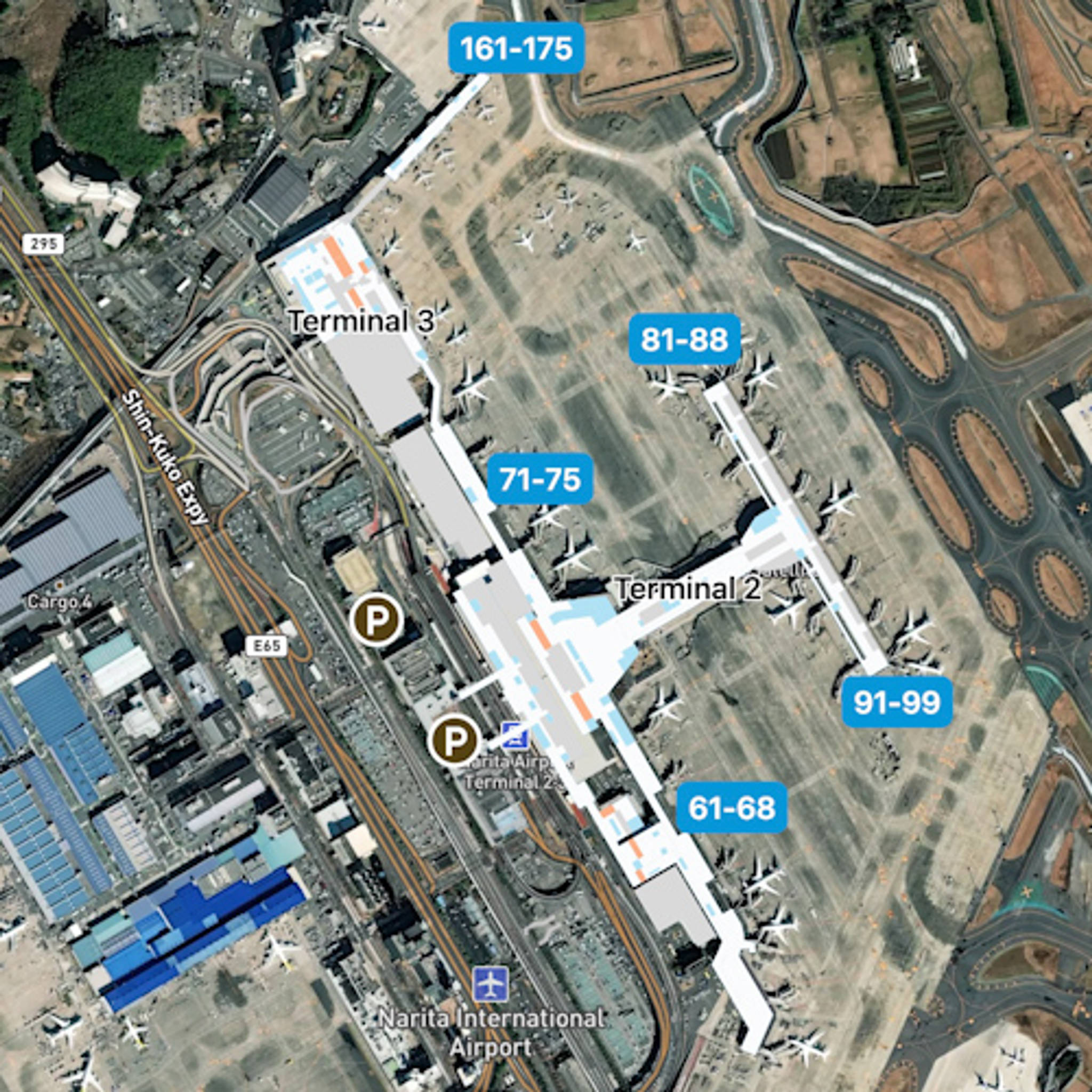
Tokyo Narita Airport Terminal Map
Getting Around NRT Airport
Navigating NRT Airport can be straightforward once you understand its layout. Terminal 1 is divided into North and South Wings, each connected to satellite buildings that house various gates. The North Wing connects to Satellites 1 and 2, while the South Wing extends to Satellite 5. Central to these wings is the Central Building, connected to Satellites 3 and 4. Terminal 2 features a main building and a satellite, linked by a walkway. For low-cost carrier operations, Terminal 3 is a separate facility located near Terminal 2.
Here are some tips for getting around inside the airport:
- Check-in and departures are generally handled on the upper floors of the terminals. Terminal 1 processes check-ins on the fourth floor, with departures on the third. Terminal 2 also follows a similar setup.
- If you're transferring between international and domestic flights, especially in Terminal 2, be prepared to exit the gate area and walk to a separate check-in area for domestic flights.
- For dining and shopping, Terminal 1’s Central Building fourth floor and Terminal 2's "Narita 5th Avenue" are your go-to spots.
Check out which airlines serve each terminal at NRT for a smoother travel day.
Frequent Flier Terminal Tips
To help you navigate the airport terminals with ease, we've gathered the best advice and tips from NRT-based frequent travelers, flight attendants, pilots, and airport staff. Their first-hand insights will guide you through the NRT terminals for a smoother travel experience. Here's what they have to say:
"If you're flying with ANA, head to Terminal 1. It's got a great selection of lounges and the check-in process is usually quick." — Kenji M., Narita, February 2025
"Last time I was at the airport, I found that the free Wi-Fi is strongest near the Central Building in Terminal 1. Great for catching up on emails before a flight." — Yuki S., Chiba, March 2025
"For the best food options, check out the fourth floor of Terminal 1's Central Building. There's a variety of restaurants that cater to different tastes." — Haruto T., Sakura, April 2025
"If you're in a rush, the fast track lanes in Terminals 1 and 2 are lifesavers. Just make sure you have a Fast Travel Pass or frequent flyer status." — Aiko R., Narita, May 2025
"Traveling with kids? The play areas in Terminal 2 are a great way to keep them entertained while waiting for your flight." — Mei L., Narita, June 2025
"Don't miss the duty-free shops in Terminal 2's 'Narita 5th Avenue.' They have some great deals on cosmetics and electronics." — Takumi N., Inzai, July 2025
"For a quick transfer between international and domestic flights in Terminal 2, be ready to exit the gate area and re-check in. It's a bit of a walk, so plan accordingly." — Satoshi K., Narita, August 2025
iFly Tip: Visit our Flying with Children page for tips on making air travel easier for both parents and kids.
Security & Screening
In this section, you will find detailed information about the security and screening processes at the airport. Learn about the locations of security checkpoints, the availability and locations of fast track lanes, and the procedures for passport and immigration control. Additionally, discover how to renew or enroll in TSA PreCheck to expedite your security screening experience.
Locations of Security Checkpoint(s)
Tokyo Narita Airport has security checkpoints located in each of its three terminals. These checkpoints are located near the entrances of the departure areas. Passengers are required to pass through security before entering the departure gates. The security checkpoints are equipped with X-ray machines and metal detectors to ensure the safety of all passengers and their belongings.
Fast Track Lanes and Locations
Fast track lanes are available for passengers who want to skip the regular security lines and get through security quickly. These lanes are located in Terminal 1 and Terminal 2. Passengers can access the fast track lanes by purchasing a Fast Travel Pass or by being a member of a frequent flyer program. The Fast Travel Pass can be purchased online or at the airport. The fast track lanes are marked with signs and are easily accessible from the main security checkpoints.
Passport & Immigration Control Locations
Passport and immigration control is located in each of the three terminals at Tokyo NRT Airport. Passengers arriving in Japan must pass through immigration control before they can enter the country. The immigration control area is located near the baggage claim area in each terminal. Passengers are required to present their passport and other necessary documents to the immigration officer. The process usually takes around 30 minutes, but can take longer during peak travel times.
Ready to Renew or Enroll in TSA PreCheck* for Faster Travel?
Renew Your TSA Pre Membership
Is your TSA PreCheck membership expiring soon? Renew your 5-year membership online with ease through this exclusive iFly offer. Continue to enjoy the benefits of faster airport security, including shorter lines and the convenience of not having to remove shoes, belts, or laptops. Don’t wait—Renew today!
Enroll in TSA PreCheck
If you’re new to TSA Pre, now is the perfect time to enroll! Take advantage of this offer to join the program and start enjoying stress-free travel. With PreCheck, you’ll breeze through airport security with shorter lines and no need to remove shoes, belts, or laptops. Enroll Now!
*TSA Precheck is available to U.S. citizens, U.S. nationals, and lawful permanent residents.
iFly Tip: Ensure a smooth airport experience by following our airport wait times advice.
Food, Shops & Services
Tokyo Nariata is a great place for food and shopping. The airport has a wide range of restaurants, cafes, and shops that cater to every taste and budget. Whether you are looking for a quick bite or a gourmet meal, you will find something to suit your palate. The airport also has a variety of duty-free shops where you can buy souvenirs, cosmetics, and electronics at discounted prices.
In addition to food and shopping, Narita offers a range of amenities to make your travel experience comfortable and convenient. The airport has free Wi-Fi, charging stations, and lounges where you can relax and unwind before your flight. There are also prayer rooms, smoking areas, and a medical center in case of emergencies. If you are traveling with children, the airport has play areas and baby care rooms to keep them entertained and comfortable.
Whether you are departing from or arriving at NRT, you will find plenty of food, shopping, and amenities to make your journey a pleasant one. So, sit back, relax, and enjoy your time at the airport.
Check out our restaurants and stores directory to learn more about food and shopping choices at the airport.
Baggage Claim Areas
the airport has several baggage claim areas located in each terminal. Upon arrival, passengers can follow the signs to their designated baggage claim area. The airport provides baggage carts free of charge in the baggage claim areas for passengers to use.
About this Page: Please note that while we strive to keep the content on this page current and accurate, we cannot guarantee it due to the ever-changing nature of airports and airlines; for more details about our data and practices, refer to our Trust & Transparency statement. To report any data issues, use our feedback form.
iFly Tip: Discover how cockpit teams handle in-flight emergencies in our cockpit safety protocols section.
Tokyo Narita Terminal Q&A
Find more help here for your journey through the airport